You Won’t Believe How Lagos Comes Alive in These Public Spaces
Lagos, Nigeria doesn’t just buzz — it pulses, especially in its public spaces. I never expected to feel so connected in a city of over 15 million people. From the morning rush at Oshodi Market to sunset at Landmark Beach, public spaces here are where life unfolds raw and real. They’re not just places on a map — they’re stages for culture, chaos, and community. This is more than urban design; it’s the soul of the city, beating loud and proud.
The Heartbeat of Lagos: What Makes Public Spaces So Vital?
Lagos is not just Nigeria’s largest city — it is one of the fastest-growing urban centers in Africa, with an estimated population exceeding 15 million and a density that shapes every aspect of daily life. In such a dynamic environment, public spaces serve as essential infrastructure. They are not luxuries or decorative afterthoughts but critical nodes where people meet, move, trade, and breathe. These spaces range from bustling markets and transport terminals to waterfront promenades and green parks. Each plays a unique role in sustaining the rhythm of urban life, offering both function and connection in a city that never slows down.
What sets Lagos apart is how organically its public spaces emerge and evolve. Unlike many global cities where urban planning precedes development, Lagos often grows from the ground up, shaped by necessity and community use. A roadside patch becomes a gathering point; a beach transforms into a weekend escape; a transit hub evolves into a marketplace. These transformations reflect resilience and adaptability. The city’s public spaces are not always formally designated, but they are deeply embedded in the social fabric. They accommodate informal trade, foster neighborhood ties, and provide rare opportunities for collective leisure in an otherwise fast-paced environment.
Moreover, these spaces serve as equalizers. In a city marked by economic disparities, public areas remain among the few places where people from all walks of life intersect. A corporate worker might haggle beside a street vendor at Mile 12 Market; families from different neighborhoods share space on Lekki Beach. This shared experience fosters a sense of belonging that transcends class. While challenges like overcrowding and maintenance persist, the sheer vibrancy of these spaces speaks to their importance. They are not just places to pass through — they are places to belong, to participate, and to witness Lagos at its most authentic.
Market Culture as Public Theater: The Case of Balogun and Mile 12 Markets
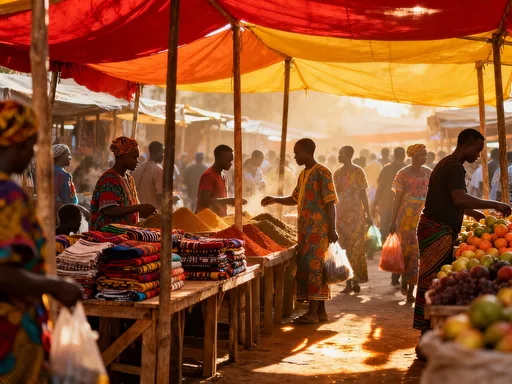
If Lagos has a heartbeat, it can be felt most strongly in its markets. Balogun Market, located in the heart of Lagos Island, is more than a shopping destination — it is a sensory symphony. As dawn breaks, the narrow aisles fill with bolts of colorful Ankara fabric, stacks of shoes, and pyramids of electronics. Vendors call out prices in Yoruba, English, and pidgin, their voices weaving through the air like threads in a tapestry. The scent of roasted plantains mixes with diesel fumes and perfume samples. Shoppers navigate the maze with practiced ease, bargaining with smiles, touching fabrics, and pausing for a quick cup of tea at a roadside stall. Every movement is part of a choreography perfected over decades.
Balogun is not just a marketplace — it is a social institution. Women meet here not only to buy supplies but to exchange news, celebrate milestones, and offer support. Young apprentices learn trades on the job, while elders dispense wisdom between transactions. The market functions as a living network, connecting people across generations and neighborhoods. Economically, it is a powerhouse, employing thousands and contributing significantly to local commerce. But its value extends beyond economics. It is a space of cultural preservation, where traditional textiles, languages, and customs remain alive and visible.
Just as vital is Mile 12 Market in the northeastern part of the city. Known for its agricultural trade, it pulses with the energy of farmers, wholesalers, and transporters. Crates of tomatoes, peppers, and onions arrive daily from across the country, creating a vibrant mosaic of color and scent. Unlike Balogun’s focus on manufactured goods, Mile 12 is rooted in food — the most fundamental form of human connection. It is not uncommon to see families shopping together, selecting ingredients for evening meals, or negotiating bulk purchases for community events. The market also hosts informal financial exchanges — small loans, barter deals, and shared transportation arrangements — all part of an unspoken economy that keeps the city running.
For visitors, these markets offer unparalleled immersion. To experience them fully, timing matters. Early mornings bring cooler temperatures and fresher produce, while midday offers the peak of activity. Respectful engagement enhances the experience — a simple greeting in Yoruba, asking before taking photos, and polite bargaining go a long way. While the crowds can be overwhelming, they are also part of the charm. These markets are not curated for tourists; they exist for the people of Lagos. To step into them is to witness the city’s spirit in motion — unfiltered, energetic, and deeply human.
Waterfront Life: From Tarkwa Bay to the Eko Atlantic Edge
Lagos is a city shaped by water. With a long coastline and numerous lagoons, its relationship with the sea is central to its identity. Public spaces along the waterfront reflect this connection in diverse ways — from the grassroots energy of Tarkwa Bay to the sleek modernity of Eko Atlantic’s promenade. These contrasting environments reveal not only different approaches to urban design but also different visions of access, leisure, and community.
Tarkwa Bay, accessible only by boat from the mainland, feels like a hidden world. The short ride across the lagoon offers a shift in pace — from traffic and noise to the rhythm of waves and birdsong. Upon arrival, visitors find a relaxed, informal beach setting where families spread out on mats, children splash in shallow waters, and vendors grill fish over open fires. There are no luxury loungers or high-end cafes, but there is an undeniable sense of freedom. Locals gather for weekend getaways, birthday celebrations, and quiet reflection. The lack of formal amenities is balanced by creativity — people bring their own chairs, coolers, and music, turning the space into a shared, self-organized retreat. It is a rare example of public space shaped entirely by community use, not corporate planning.
In contrast, Eko Atlantic’s waterfront is a vision of the future. Built on reclaimed land, this planned district features wide, paved walkways, landscaped gardens, and panoramic views of the Atlantic Ocean. The promenade is designed for walking, jogging, and socializing, with designated seating areas and lighting for evening use. On weekends, families stroll together, couples take photos against the skyline, and fitness groups gather for outdoor classes. The atmosphere is orderly, clean, and intentional. Yet, questions remain about accessibility. While open to the public, the area’s location and surrounding developments cater largely to higher-income residents and visitors. This raises important conversations about equity in urban design — who gets to enjoy Lagos’s most beautiful spaces, and how can waterfront access be more inclusive?
Both Tarkwa Bay and Eko Atlantic highlight the emotional and social value of waterfront spaces. Water has a calming effect, offering respite from the city’s intensity. Whether through a rustic boat ride or a polished evening walk, these areas provide opportunities for connection — with nature, with family, and with the city itself. As Lagos continues to grow, protecting and expanding public access to its coastline will be crucial. The ideal future may lie in blending the best of both models: the inclusivity and spontaneity of Tarkwa Bay with the safety and design of Eko Atlantic.
Green Oases in a Concrete Jungle: Lekki Conservation Centre and Muri Okunola Park
In a city defined by density and motion, green spaces are more than aesthetic additions — they are lifelines. The Lekki Conservation Centre, spanning over 78 hectares on the Lekki Peninsula, is one of Lagos’s most significant natural sanctuaries. Its centerpiece, the 401-meter canopy walkway, floats above the treetops, offering breathtaking views of the forest and lagoon. Below, trails wind through mangroves, grasslands, and wetlands, home to monitor lizards, monkeys, and over 180 bird species. The air is thick with the sounds of insects and rustling leaves — a stark contrast to the city’s usual noise.
More than a nature reserve, the center serves as an environmental education hub. School groups visit for guided tours, learning about conservation, biodiversity, and climate resilience. Families come on weekends to escape the heat, picnic under shade trees, and walk the trails at a slower pace. The conservation center also hosts events like clean-up campaigns and tree-planting drives, fostering a sense of stewardship among residents. Its existence is a testament to the possibility of coexistence between urban growth and ecological preservation. In a city where land is at a premium, protecting such spaces requires constant advocacy and community support.
Equally important is Muri Okunola Park, located in the bustling Victoria Island district. Smaller in scale but high in impact, this park offers a rare green pause in one of Lagos’s busiest commercial areas. Office workers take lunch breaks on its benches, children play on the swings, and fitness enthusiasts use the jogging paths. The park’s design is simple but effective — open lawns, shaded seating, and clean walkways make it accessible and welcoming. Unlike some under-maintained public areas, Muri Okunola benefits from consistent management and community engagement, ensuring it remains a safe, clean, and functional space.
Together, these green spaces illustrate the growing recognition of urban nature as essential infrastructure. They improve air quality, reduce heat, and support mental well-being. But they also fulfill a deeper human need — the desire to connect with something calm and enduring amid constant change. As Lagos expands, the challenge will be to integrate more such spaces into new developments, ensuring that every neighborhood has access to nature. The success of Lekki Conservation Centre and Muri Okunola Park offers a blueprint: design with care, maintain with diligence, and involve the community at every step.
Transport Hubs as Unofficial Public Squares: Oshodi and Yaba Bus Terminals
In most cities, transport hubs are designed for efficiency — get in, get out. But in Lagos, places like Oshodi and Yaba Bus Terminals have evolved into something more. They are not just transit points but social centers, economic zones, and informal meeting grounds. Here, people don’t just pass through — they linger, trade, eat, and connect. The boundaries between movement and stay blur, creating dynamic spaces that reflect the city’s improvisational spirit.
Oshodi, one of the busiest interchanges in Lagos, is a study in controlled chaos. Buses, danfos (minibuses), and motorcycles converge from all directions, their horns creating a constant rhythm. Amid the flow, a parallel economy thrives. Women balance trays of snacks on their heads, selling puff-puff and boiled eggs. Men offer phone charging services, tire repairs, and spare parts. Barbers set up chairs on the sidewalk, giving quick haircuts between arrivals. The terminal hums with activity from dawn to late evening. While the noise and crowds can be overwhelming, there is also a sense of order — an unspoken understanding of how things work, passed down through daily use.
Yaba, known as Lagos’s tech hub, presents a different energy. Located near universities and innovation centers, its bus terminal attracts students, young professionals, and entrepreneurs. The atmosphere is more modern, with digital payment kiosks and better signage. Yet, it too hosts informal commerce — phone accessory vendors, book sellers, and food carts offering jollof rice and suya. What makes Yaba unique is its role as a knowledge crossroads. Conversations here often turn to startups, education, and career opportunities. It is not uncommon to overhear discussions about coding bootcamps or internship prospects, turning the terminal into an impromptu networking space.
Both terminals highlight how public infrastructure can adapt to human needs. While neither was originally designed as a social space, their function has expanded because people demand more than just transportation. They need places to earn, eat, and interact. Recognizing this reality, recent urban initiatives have begun to improve safety, lighting, and sanitation in these areas. The goal is not to sanitize their character but to support their organic vitality while making them more inclusive and secure. When transport hubs serve as public squares, they become more than connectors — they become communities.
Arts and Expression in Shared Spaces: Murals, Pop-Ups, and Festivals
Art in Lagos is not confined to galleries — it spills into the streets, transforming everyday spaces into open-air canvases. Across the city, vibrant murals depict cultural icons, historical moments, and social messages. In neighborhoods like Ajah and Surulere, walls once marked by neglect now tell stories of resilience, pride, and aspiration. These works are often created by local artists, sometimes in collaboration with community groups, turning public art into a form of collective expression.
One of the most powerful aspects of street art in Lagos is its accessibility. Unlike museum exhibitions that may require admission or cultural capital, murals are free and visible to all. A child walking to school, a motorist stuck in traffic, a vendor setting up shop — each encounters art as part of daily life. This democratization of creativity ensures that artistic expression is not reserved for the elite but shared by the many. Themes often celebrate Nigerian heritage — from traditional attire to proverbs in local languages — reinforcing cultural identity in a globalized world.
Beyond static murals, pop-up galleries and performances are breathing new life into underused spaces. Freedom Park, a former colonial prison turned cultural center, hosts poetry slams, live music, and art exhibitions every weekend. Abandoned lots are temporarily transformed into creative hubs during events like the Lagos Photo Festival or Art Lagos. These temporary interventions challenge the notion that public space must be permanent to be valuable. Even a short-lived installation can spark conversation, inspire pride, and activate a forgotten corner of the city.
Festivals further amplify this spirit. The annual Lagos Carnival, held around October, turns streets into moving stages of color, music, and dance. Participants wear elaborate costumes representing different states and traditions, creating a floating celebration of national unity. The event draws thousands, from local residents to international visitors, turning the city into a shared stage. Such festivals do more than entertain — they build social cohesion, celebrate diversity, and remind people of their shared belonging. In a rapidly changing urban landscape, public art and cultural events anchor Lagos in its values and stories.
Designing for People: Challenges and Hopes for Lagos’s Public Spaces
The future of Lagos’s public spaces is both promising and precarious. On one hand, the city’s organic vibrancy demonstrates an incredible capacity for self-organization and community resilience. On the other, rapid urbanization, climate pressures, and inequality pose serious challenges. Overcrowding strains infrastructure, waste management remains inconsistent, and access to quality public spaces is still unevenly distributed. Coastal areas face erosion and flooding, threatening waterfront communities and developments alike. Without intentional planning, these issues could erode the very qualities that make Lagos’s public life so special.
Yet, there is reason for hope. Community-led initiatives are gaining momentum. Neighborhood clean-up campaigns, youth-led art projects, and resident associations advocating for better parks show that people are invested in shaping their environments. City planners are beginning to listen, incorporating feedback into new projects and prioritizing pedestrian-friendly designs. The introduction of dedicated bus lanes, improved lighting, and more green zones reflects a growing understanding that urban spaces must serve people, not just vehicles.
Inclusivity remains a key goal. For public spaces to truly represent Lagos, they must be accessible to all — regardless of income, age, or ability. This means investing in safe sidewalks, affordable transport links, and multi-use areas that welcome diverse activities. It also means preserving informal spaces — markets, roadside stalls, and neighborhood hangouts — that may not fit traditional planning models but are vital to daily life. The challenge is to modernize without displacing, to improve without excluding.
Climate resilience must also guide future development. Green infrastructure — such as permeable pavements, urban forests, and stormwater gardens — can help manage flooding while enhancing public areas. Renewable energy lighting, shade structures, and water-efficient landscaping can make spaces more sustainable and comfortable. As Lagos grows, integrating environmental considerations into urban design will be essential for long-term livability.
In the end, the power of Lagos’s public spaces lies in their aliveness. They are imperfect, sometimes chaotic, often crowded — but they are real. They reflect the city’s energy, creativity, and spirit of connection. Whether in a bustling market, a quiet park, or a busy terminal, people come together, not by design, but by desire. They seek community, expression, and belonging. The task ahead is not to perfect these spaces but to protect their soul — to ensure that as Lagos evolves, its public heart continues to beat, loud and proud.